By David W. Fukumoto
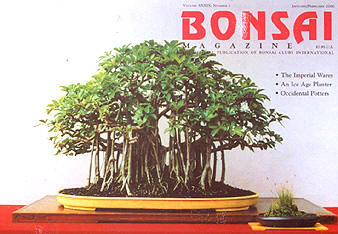
A dwarf Schefflera trained since 1976, featured on the front-and-back cover of the January–February 2000 issue of Bonsai Magazine, published by Bonsai Clubs International. Dwarf Schefflera can be grown indoors in homes and offices, or outdoors when night temperatures are above 55°F.
Most people kill their bonsai because they purchased or were given the wrong tree that could not grow in their conditions. Much of this is due to the term "INDOOR BONSAI" being used very loosely. When bonsai was being introduced into the United States by servicemen returning from occupied Japan after World War II, "BONSAI" only meant "Japanese temperate climate bonsai to be grown outdoors."
"INDOOR BONSAI" is an American innovation that largely began in the 1960's. Ernesta Ballard, the president of the Pennsylvania Horticultural Society, wrote an early book about her experiences of growing and wintering-over ficus plants that she had acquired in Florida during her vacations. They were easier and more successfully wintered indoors and grown outdoors in warmer seasons compared to traditional Japanese temperate climate bonsai that required the use of cold frames in her area.
Others associated with the American Bonsai Society also wrote about their experiences. Constance Derderian, curator of the Lars Anderson Bonsai Collection at Arnold Arboretum, edited the first major Brooklyn Botanic Garden handbook on the subject. Its title, Bonsai for Indoors, reflected the potential confusion surrounding the phrase “indoor bonsai”.
There are many kinds of bonsai. Dividing them into just two categories, “outdoor bonsai” and “indoor bonsai”, does not adequately describe their different growing requirements.
Success or failure will depend upon the tree's natural climatic range and it's light and cultural requirements. Most temperate climate bonsai will not grow well in the tropics or indoors. They likely need a winter dormancy even if they have low-light or shade tolerant traits. Most tropical plants will not grow in temperate climates as they can't handle the winter cold. They will grow indoors in temperate climates if they are kept warm and their light and other cultural requirements are met. Tropical plants are not all houseplants that can be grown indoors for long periods and they need specific conditions and care.
Do the trees show up in "houseplant" magazines? Most tropical or imported Chinese bonsai plants are not featured in houseplant magazines, but they are very commonly labeled "INDOOR BONSAI." This is a very questionable and simplistic practice. Trees don't magically become indoor plants because they are called "bonsai." That's like saying "polar bears can live in tropical Hawaii." It's silly and misleading to make such statements without all other necessary information.
Even known houseplants often need much more light than is available in most homes and offices! The most notable are members of the Ficus or Fig family. With the exception of the Mistletoe Fig (Ficus deltoidea syn. Ficus diversifolia), most ficus bonsai need more light than available on window sills. To thrive, they need to be kept warm, but also be given the stronger light or glasshouse conditions. Ficus authority Jerry Meislik has found that some ficus species have significant temperate climate traits and tend to exhibit seasonal fall defoliation. These may not do as well in heated greenhouses. There's a large range of opinions regarding the use of the term "INDOOR BONSAI." I think it should mean plants that are recognized as "houseplants" that can thrive indoors in homes and offices. Although many plants can be grown outdoors when night temperatures exceed 55°F, these plants are primarily grown indoors, not just to protect them against the cold during winter.
Each species must be tested; although there may be a varietal exception that a single grower has been successful, the exception does not justify listing such plants as indoor bonsai. There are a wide range of pines and junipers and because a few varieties can adapt to the tropics and individuals have successfully grown them indoors with supplemental light and special conditions for a year or so, they are labeled and sold as INDOOR BONSAI. Survival for a year or two under special conditions does not demonstrate that a tree is suitable for long-term indoor cultivation.
Recommendations for improved terminology and care information
We are in a rapidly growing age of "International Bonsai" in which endemic trees of all climatic origins are being grown as bonsai and the number of trees being trained as bonsai is growing dramatically. There have been attempts to grow temperate climate trees in tropical Hawaii by providing an annual artificial dormancy in chillers or commercial refrigerators. This effort to fool Mother Nature was only successful for a year or two.
Trees of different climatic origins require different care depending on where they are grown. A general guide should explain how specific plants should be grown in the major climatic zones, both indoors and outdoors. Useful information includes the correct botanical name, where the tree was grown and trained, and its cultural, light and temperature requirements.
More precise descriptions can include “tropical bonsai”, “Chinese penjing” or “shade-tolerant temperate-climate bonsai”. These terms should be supported by information about the particular plant and its growing requirements; a broad label alone does not establish whether a tree will thrive indoors.
Bonsai and indoor growing conditions
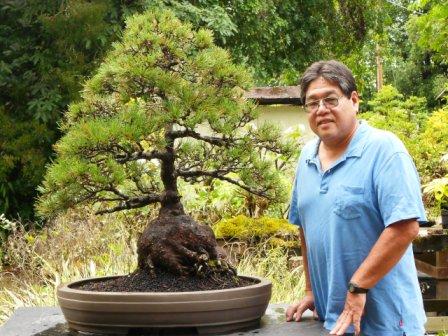
Michael Imaino with the Haruo “Papa” Kaneshiro memorial bonsai in the Hawaii State Bonsai Repository. This Japanese black pine was already mature when it was left in Hawaii in the late 1800s. Japanese black pine is one of the few temperate-climate trees that can adapt to the tropics, but it needs full sun and cannot be grown indoors.
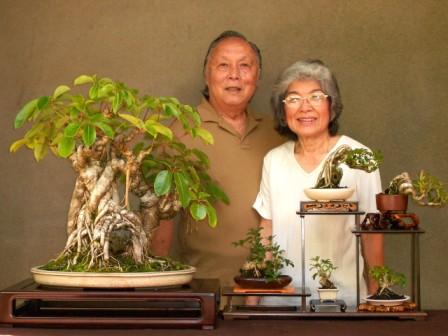
David and Myrtle Fukumoto with a Schefflera (Brassaia actinophylla) that began as a bonsai in 1962 and had been in training for 50 years when photographed in 2012.
Dwarf Schefflera can be trained into a wide range of bonsai styles. Useful characteristics in prepared bonsai stock include character within one inch of the soil line: a heavy trunk base, taper, low branches or multiple trunks, together with a shallow, compact root system.
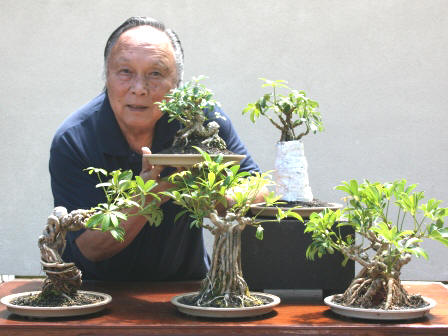
Dwarf Schefflera bonsai can be developed in a range of sizes and styles, including stout “Sumo”, exposed-root “Roots” and twisting “Hawaiian Dragon” forms.
Planting into shallow saucers demonstrates that bonsai can be grown with a limited amount of soil. The amount of soil, root system and care regime must suit the plant and its growing conditions.
Further reading: an introduction to true indoor bonsai
Adapted from Fuku-Bonsai’s archived article by David W. Fukumoto, with images recovered from earlier captures. Business promotions and contact details have been omitted. © Fuku-Bonsai, 2015.